
Why Does My Cat Bite Me Then Lick Me? (Strange Behavior Explained).
Why does my cat bite me then lick me? This detailed guide explains the hidden meanings behind this behavior, from affection to overstimulation, plus proven ways to handle it correctly.
Introduction.
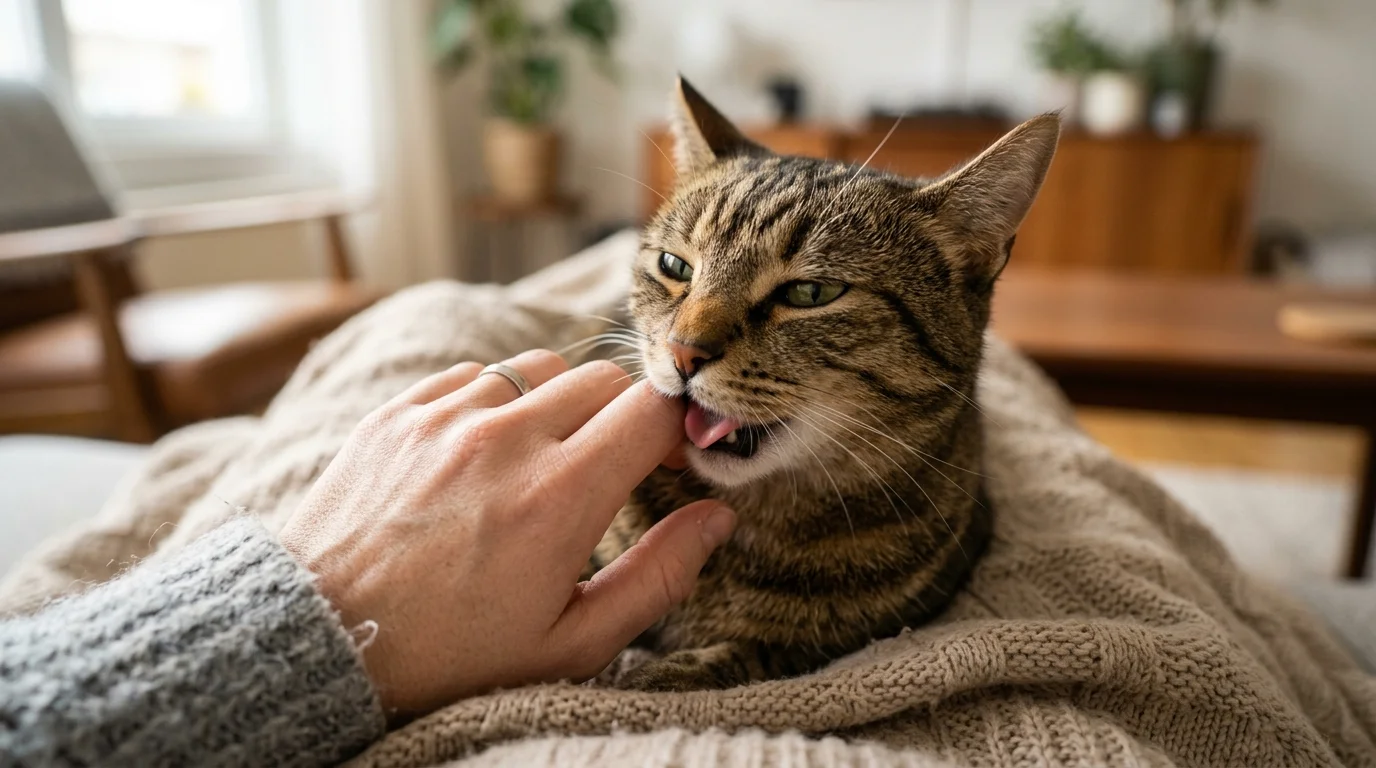
If you’ve ever been relaxing with your cat maybe petting them while they purr and suddenly they bite you, only to follow it up with gentle licking, you’re not alone. This confusing mix of affection and aggression leaves many cat owners wondering: Is my cat being loving or annoyed?
The truth is, this behavior is far more complex than it seems. Cats communicate in subtle, layered ways. A bite followed by licking isn’t random—it’s often a meaningful signal rooted in instinct, social bonding, overstimulation, or even learned habits from kitten hood.
Understanding this behavior matters. Misreading your cat’s signals can lead to stress, broken trust, or even injury. But when you interpret it correctly, it opens the door to a stronger, more intuitive bond with your feline companion.
In this deep-dive guide, we’ll explore:
•The real reasons behind this behavior.
•What your cat is trying to “say”.
•How your own actions may trigger it.
•And most importantly—how to respond the right way.
Table of Contents.
1.Why Does My Cat Bite Me Then Lick Me?
2.My Personal Experience.
3.Solutions and What I Highly Recommend.
4.FAQs.
5.Conclusion.
6.Author & Disclaimer.
1.Why Does My Cat Bite Me Then Lick Me?
This behavior usually falls under a few key explanations. Let’s break them down one by one.
1.1 Affection Mixed With Instinct.

Cats show love differently than humans. When your cat licks you after a bite, it can actually be a sign of affection and bonding.
In the wild (and even in domestic settings), cats groom each other a behavior called allogrooming. It strengthens social bonds. When your cat licks you, they may be treating you as part of their “family group.”
But where does the bite come in?
That small bite—often called a “love bite”—is usually gentle and controlled. It mimics how cats interact with each other during grooming or play.
👉In simple terms:
Bite = stimulation or communication.
Lick = bonding or soothing.
1.2 Overstimulation (The #1 Hidden Cause).

This is one of the most common reasons—and most owners completely miss it.
Cats have a low tolerance for repetitive touch. While you might enjoy long petting sessions, your cat may become overwhelmed after a short time.
Signs of overstimulation include:
•Tail flicking or whipping.
•Ears turning sideways or back.
•Skin rippling on the back.
•Sudden tension in the body.
When your cat bites, it may be saying:👉 “That’s enough.”
The licking afterward? It’s often a way to calm themselves down or diffuse the tension.
Understanding overstimulation is important because many cats have a limited tolerance for physical interaction. According to expert veterinary advice, recognizing early warning signs can prevent unwanted biting behavior.https://www.petmd.com/cat/behavior/cat-overstimulation

Kittens and young cats learn through play—specifically mock hunting.
If your cat wasn’t properly trained as a kitten to avoid biting hands, they may:
•Treat your hand like prey.
•Bite during play.
•Then lick as a natural follow-up behavior.
This doesn’t mean your cat is aggressive—it means they never learned boundaries.
1.4 Grooming You (Yes, Really).
Your cat may literally be trying to groom you.
Cats groom:
•Themselves.
•Other cats.
•Humans they trust.
Sometimes, before grooming, cats use their teeth to:
•Remove “debris” (in their mind).
•Separate fur.
Since your skin isn’t fur, it feels like a bite.
Cats often groom each other as a sign of bonding, and this behavior—known as allogrooming—is widely recognized in feline behavioral studies. You can learn more about this social grooming behavior from trusted resources like the American Society for the Prevention of Cruelty to Animals (ASPCA).https://www.aspca.org/pet-care/cat-care/common-cat-behavior-issues
1.5 Attention-Seeking Behavior.
Cats are smart. If biting followed by licking gets a reaction from you—even a negative one—they may repeat it.
This is especially true if:
•You immediately stop what you’re doing.
•You talk to them.
•You react emotionally.
From your cat’s perspective:👉 “This works. I’ll do it again.”
1.6 Stress or Anxiety Signals.
Sometimes, this behavior isn’t playful or affectionate—it’s a subtle sign of stress.
Triggers may include:
•Changes in environment.
•New pets or people.
•Lack of stimulation.
•Irregular routines.
The bite expresses tension. The licking acts as a self-soothing mechanism.
1.7 Learned Kitten Behavior.
If a kitten grows up:
•Without siblings.
•Or without proper correction.
They may not learn that biting hurts.
In natural settings, littermates teach boundaries. When one bites too hard, the other reacts. That feedback loop prevents aggressive habits.
Without it, your cat may carry kitten-level biting into adulthood.
2.My Personal Experience
I once had a cat named Leo—a calm, affectionate companion who loved attention… until he didn’t.
Every evening, Leo would jump onto my lap. I’d pet him, and he’d start purring loudly. Everything felt perfect—until suddenly, he’d bite my hand. Not hard enough to break skin, but enough to surprise me.
And then, almost immediately, he’d start licking the exact same spot.
At first, I was confused—and honestly, a bit annoyed. Was he being aggressive? Was I doing something wrong?
After observing his behavior closely, I noticed patterns:
•The biting always happened after a few minutes of petting.
•His tail would start flicking before the bite.
•His ears would slightly shift backward.
That’s when it clicked: I was overstimulating him.
Once I adjusted:
•Shorter petting sessions.
•Watching his body language.
•Stopping before he reached his limit.
The biting stopped almost completely.
And the licking? It stayed—but now it felt like what it really was: trust and affection.
3. Solutions and What I Highly Recommend.

Understanding the behavior is only half the battle. Here’s how to handle it effectively.
3.1 Learn Your Cat’s Warning Signs.
Your cat always gives signals before biting.
Watch for:
•Tail movement.
•Ear position.
•Sudden stillness.
•Dilated pupils.
👉 Stop interaction before the bite happens.
3.2 Avoid Using Your Hands as Toys.
This is critical.
If you play with your cat using your hands:
•You’re teaching them that biting skin is acceptable.
Instead, use:
•Feather toys
•Wand toys
•Balls
This redirects their natural hunting instinct safely.
Using proper toys instead of hands is strongly recommended by animal behavior experts to prevent reinforcing biting habits.https://www.humanesociety.org/resources/how-play-your-cat
3.3 Keep Petting Sessions Short and Positive.
Don’t wait until your cat gets annoyed.
👉 End interaction while they’re still enjoying it.
This builds trust and prevents negative associations.
3.4 Redirect, Don’t Punish.
Never:
•Hit
•Yell
•Physically punish
This damages trust and can increase aggression.
Instead:
•Gently withdraw your hand
•Offer a toy
•Ignore attention-seeking bites.
3.5 Provide Mental and Physical Stimulation.
A bored cat is more likely to develop strange behaviors.
Make sure your cat has:
•Daily playtime
•Environmental enrichment (windows, climbing spaces)
•Routine feeding schedules
3.6 Train Bite Inhibition.
If your cat bites:
•Freeze your hand
•Slowly withdraw
•Stop interaction immediately
Over time, your cat learns:
👉 “Biting ends the fun.”
3.7 When to See a Vet.
If the behavior:
•Becomes aggressive
•Breaks skin regularly
•Appears suddenly
Consult a veterinarian. There could be underlying issues like pain or illness.
4. FAQs.
Q1: Is it normal for cats to bite then lick?
Yes, it’s very common. It usually reflects a mix of affection, communication, and instinct.
Q2: Should I be worried about this behavior?
Not usually. However, if the bites are aggressive or frequent, it’s worth investigating further.
Q3: Why does my cat bite only me and not others?
Your cat may feel most comfortable with you—or you may unknowingly trigger overstimulation more than others.
Q4: Do cats understand that biting hurts?
Not always. Especially if they weren’t trained as kittens.
Q5: Can I completely stop this behavior?
You can reduce it significantly with training and awareness, but occasional “love bites” may still happen.
If your cat’s behavior becomes aggressive or unusual, it’s always best to consult professional veterinary guidance for accurate diagnosis and care.https://vcahospitals.com/know-your-pet/cat-behavior-problems-aggression

Conclusion.
When your cat bites you and then licks you, it’s not random—it’s communication.
It could mean:
•“I love you.
•That’s enough”“
•Let’s play”
•Or even “I’m stressed”
The key is learning to read the context and your cat’s body language.Once you understand the signals, everything changes. What once felt confusing becomes clear—and your relationship with your cat becomes deeper, calmer, and more rewarding.


One Comment